Category: WRT 110

Empathy Essay Reflection

  1. Final Thesis: I believe that empathy is in fact overrated, tends to provoke the wrong response out of the public, misused, and can leave you feeling down and exhausted. 

Strengths: Specific and makes a direct stance, gives points for evidence in paragraphs.

Weakness: Could be a little more narrow and focused even more.

2. I learned a lot about how I revise and write paragraphs during this specific essay. When I write my first draft of the essay, I tend to be very structured from the get go, and get all of my points and quotes laid out where I want them. It almost looks like a final draft, just not to my standards. As I continue to revise it after peer review, I rearrange some elements, or specify further on my main ideas. I also tend to rework my intro a lot, because the more details I add bring up important things that I feel an intro needs. My intro is also very weak compared to the rest of my essay, and since it’s the first thing I write it is sloppy, unorganized, and has no details.

3. Something that I really focused on was my intro, because I didn’t know before that introducing the main texts and their authors in the intro makes your essay stronger. I found that I needed to rework my intro a couple of times after I added the text introductions because it made it sound really weird and didn’t flow well. I didn’t like how it seemed very monotone, boring, and choppy. I thought it was choppy because I wasn’t able to connect the points before and after the introduction of the sources until after I read it over and revised some more. I really liked how professional it made my essay sound after I read it over, because I’ve never introduced the sources together in an intro paragraph. I also focused on adding the TRIAC paragraph into the final draft too, because I figured it would allow a paragraph to flow more smoothly and also make it look nice on paper as it checked all of the boxes.

4. For our next paper, I really want to think about what the prompt is so that when I’m annotating I can make annotations that are even more specific to what I believe is important and would work as strong evidence. I also want to make sure that I remember to add the source introduction in my intro paragraph the first time I write it so I can spend less time rearranging my intro, and instead focus on the strength of my body paragraphs and my conclusion. I also think that my conclusion in general needs a lot of help, and I should dedicate a lot more time to making it more useful and helpful to my essay. It isn’t anywhere close to being the same length as my intro, and I know it should be, so I just need to set aside more time to focus directly on it. I think that I could have another person read it too, just to give me more feedback on what I’ve revised from the first peer edit, and my mom wants to help since she used to be a teacher and another set of eyes on it could improve the entire paper overall.
DFW Reading Response

  1. In his speech, This is Water, DFW made three concise points that shaped the way his speech was delivered. His first claim was about how people view situations and scenarios differently, and how most of us miss what is directly in front of us. In his first paragraph, he talked about a story of three fish, two were younger and one was old and wise, and the old wise fish asked them how the water was. The fish were so confused, they didn;t know what water was, and DFW was able to relate that back and say how we are like the fish and tend to not even realize or appreciate what is directly in front of us (1). His second claim was about the power of what you pay attention to. He went on and on about how you can be frustrated with a ton of things going on during your day, and how you could complain about the squeaky cart in the grocery store or the cars on the road. While you could focus on the negatives, DFW made it his mission to teach us “that you get to decide how you’re gonna try to see it” (5). He explained how you could go through life and everyday just being negative and only focusing on yourself, or you could try to see it from another perspective and not get so angry at the vars because maybe they are in a rish to get to the hospital or maybe they’re having a rough day visiting someone sick. The point that he was trying to make is that it is up to you to decide how you see the world. 

The third claim was that you have to do your best to change the default setting. The default setting is being negative and seeing the worst in things around you. DFW explained that changing your default setting “is real freedom. That is being educated, and understanding how to think (6). Instead of going through life doing the bare minimum and unhappily, you can reset yourself to not worship money or power, but instead worship something different because those things will constantly make you feel as if you never have enough and you’re never satisfied. 

  1. I do agree with his main arguments because you truly never do know what other people are going through. It would also be a very miserable life if you only looked at the bad things and complained about everything. 
  2. I don’t believe that he’s hinting on empathy at all, it’s definitely something else. DFW spends the entirety of his speech talking about how you can view the world, and how everyone sees it differently. I think that he was hinting on kindness and compassion instead of empathy, because he wasn’t telling the audience to feel the emotions of others around you, and with empathy you can only give it to a small number of people, so having empathy for everyone in the grocery store or on the road is not logical. However, having compassion and being kind doesn’t have a limit on how many people you can focus on, so that is what he was hinting on. 
  3. “The capital-T Truth is about life BEFORE death” (6). I agree with his statement about life before death because he was preaching about how you get to choose how you see the world and how you think about things. If you don’t live the way you want to live, then what is the point, and how can you say you lived life on your own terms and had your own thoughts? 
  4. DFW’s main points collide with Bloom’s points because they challenge the societal norms of today. Bloom was challenging empathy, which today is a popular word that everyone knows and every kid at school learns about. DFW was talking about how you can change the default setting of only thinking about yourself, and it connects to Bloom’s because they both are unconventional ideas that people either really resonate with or really don’t agree with at all.

Bloom Reading Response

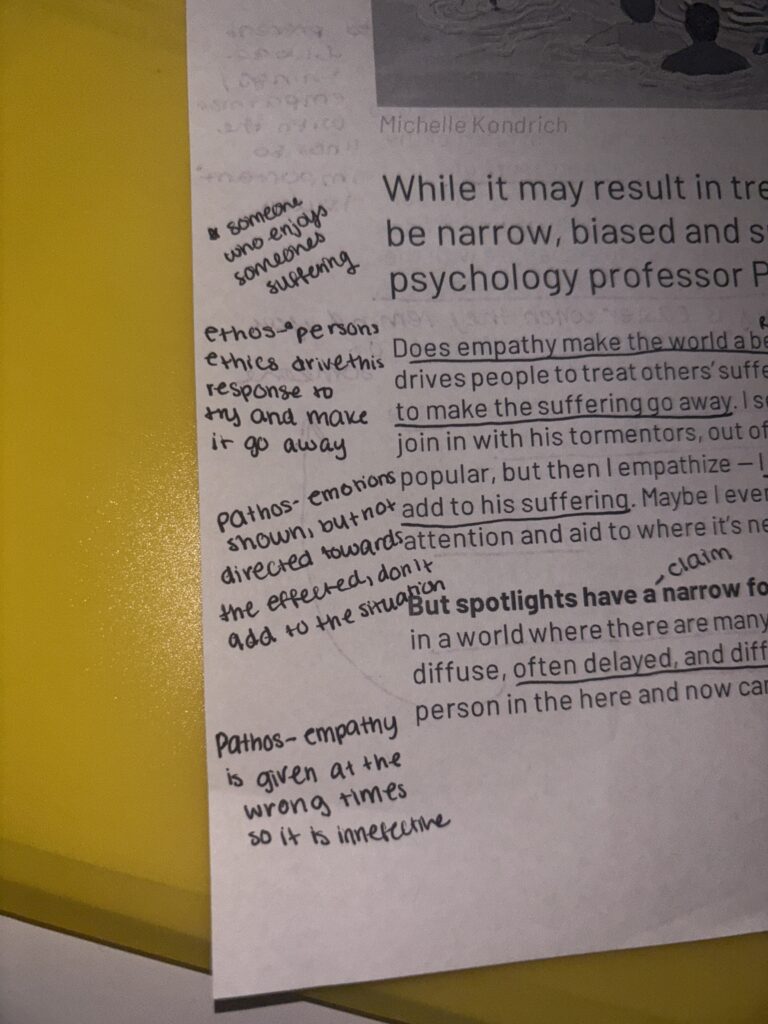
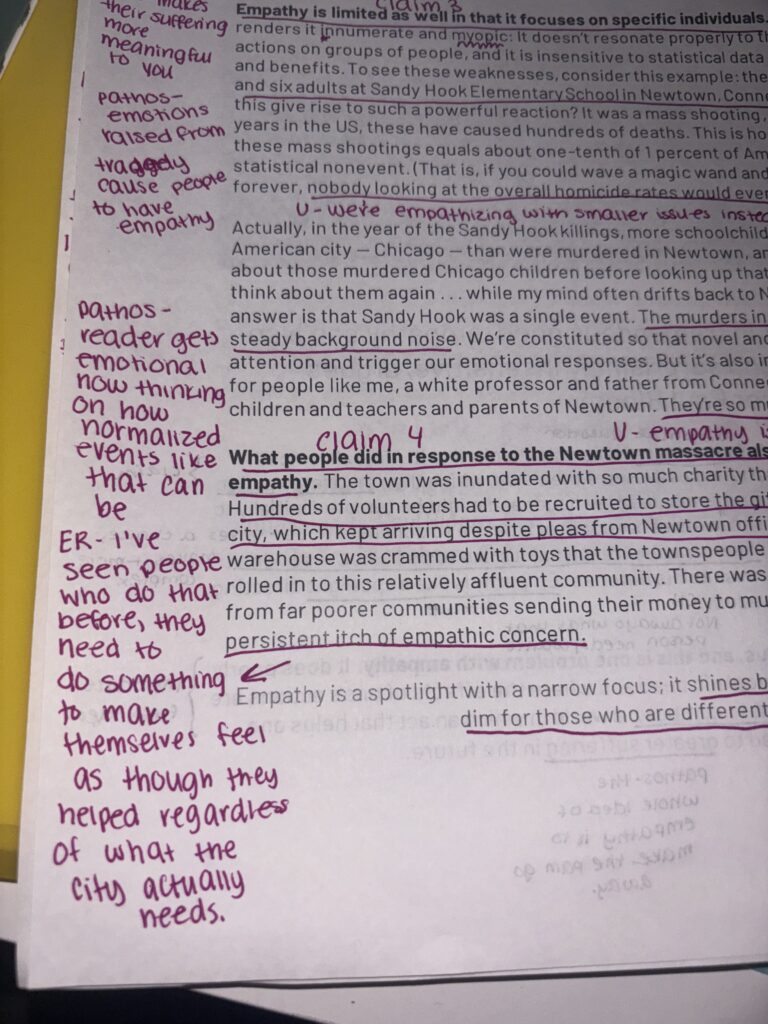
  1. In Bloom’s article on empathy, he discussed how empathy is biased towards people you know, or those who are closer to you. He talks about how much energy it takes to show empathy to everyone who needs it, which is basically the entire world since nobody’s life is perfect, and how there are other ways that you can spread kindness. Bloom made three main points in his nine total claims, one that empathy is biased, another being that empathy causes irrational and unreasonable responses, and the third being that there are better ways to spread kindness than empathy. In Bloom’s third paragraph he talks about how it’s “easier to empathize with those who are close to us, those who are similar to us, and those we see as more attractive or vulnerable and less scary” (2). When he says this, it highlights how empathy is a spotlight on a singular person, and we tend to only see into the lives of those who are close to us which allows us to see the bad things that occur and show empathy towards them. His second main idea was about the responses that occur in the act of empathy, like in paragraph six he mentioned that “hundreds of volunteers had to be recruited to store the gifts and toys that got sent to the city, which kept arriving despite pleas from Newtown officials for people to stop”(2). Empathy causes people to feel as though they must do something to try and make the pain worse, like in this scenario it was sending gifts and toys, but these actions aren’t always necessary. Finally, Bloom preaches that “the negatives outweigh its positives – and that there are better alternatives” to empathy and spreading kindness (4). Bloom gives examples of alternatives, some being self-control, intelligence, and compassion to better the outcome and spread kindness. 
  2. I personally do agree with Bloom’s argument that empathy is overrated. There are days when I notice that people around me are searching for empathy, instead of trying to do something to help themselves. I tend to not pay much attention to social cues like these, so when I do notice them that means that the begging for empathy is intense. Bloom also made memorable points and arguments that swayed me further to agree with him.
  3. Bloom challenged my initial understanding of empathy because I always thought empathy was able to be given to a large number of people at the same time, but now looking back on it after reading that paragraph I can see that it wasn’t empathy, it was just me feeling sorry for them. I also didn’t realize that there is a spotlight with empathy, and that you only see what people allow you to see so maybe they don’t have a spotlight but they need kindness and support too. 
  4. “Further, spotlights only illuminate what they are pointed at, so empathy ref;ects our biases” (2). I support this claim that he makes because it is true, and looking back on my own life and experiences, I definitely empathize much more with those I’m closer to. When you know the person that this incident occurred to, it makes it so much easier to empathize with them because you always think ‘they didn’t deserve this’, or ‘why does this have to happen to them’ since you know a lot about their life. I’ve noticed it’s harder for me to empathize with people I’ve never met, or people in different countries.
  5. Why do people feel the need to send things like gifts to communities who have been hurt as a form of empathy?

First Writing Project

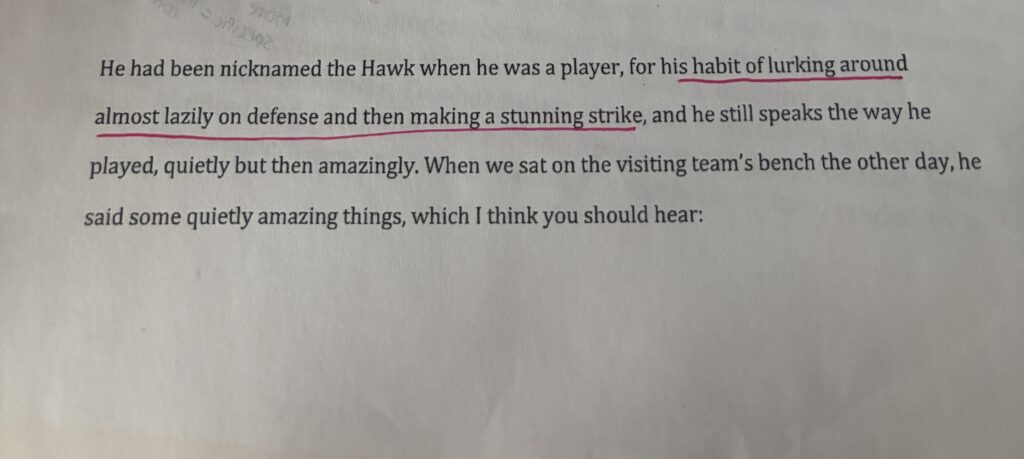
I always used to think that I was good at annotating, maybe because my handwriting is neat and I used fun colored pens that made it look like I was writing a ton of notes, but recently I’ve come to the realization that my annotating skills are not what I thought they were. In my annotations for The Hawk, they were superficial, just barely summarizing what was happening or what my thoughts were at that moment. I also tended to just underline sentences, thinking that it would be helpful later on, however, that just forces me to reread large sections to try to attempt to understand why that line was important. At the bottom of page one of The Hawk, you can see how I simply just underlined a sentence and called that good. One of my annotations from The Hawk was related to the reporter and what she was looking for and I wrote “the reporter wanted a sob story, not a story about how the community cared for him.” This annotation was completely unnecessary as the author made statements about how that was the entire point of the story Hawk was telling Doyle. My annotations for this story would look completely different if I had been using the annotation guide because I could have made connections to my life and would have actually written helpful notes in the margin instead of just writing to fill space. 

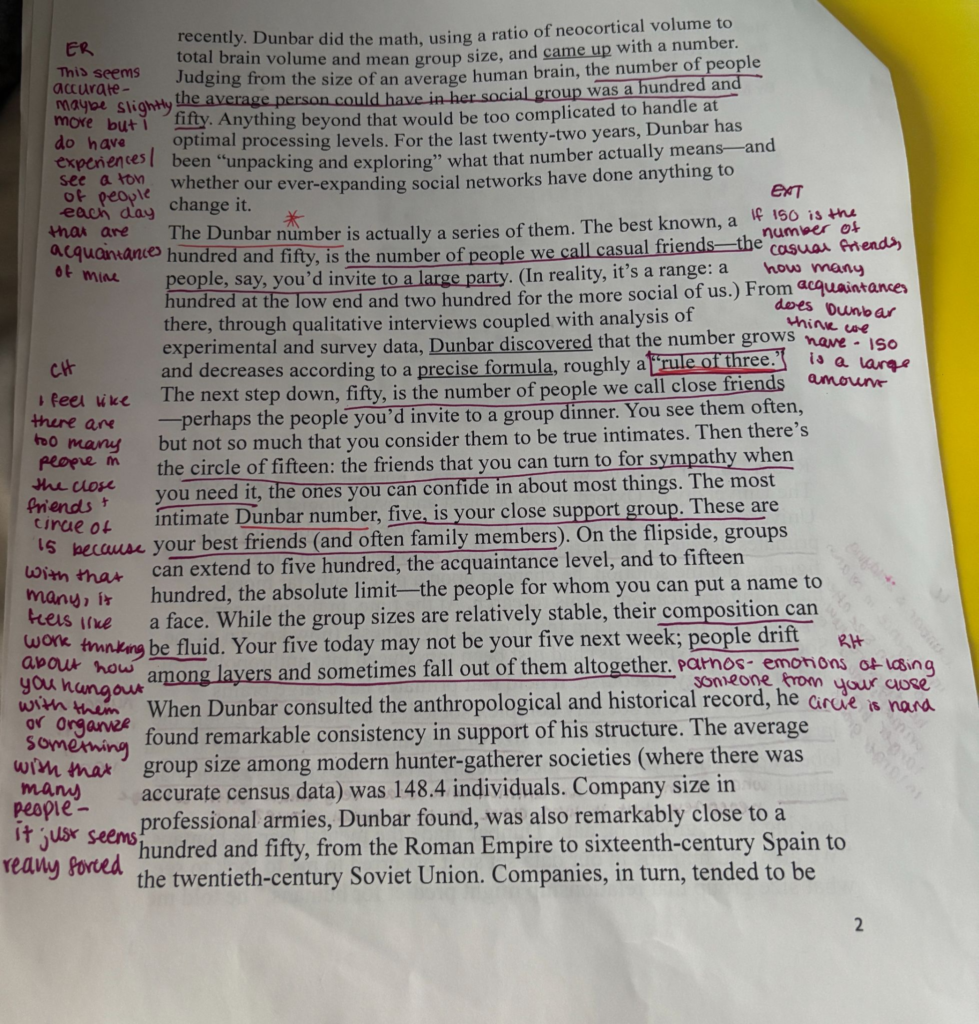
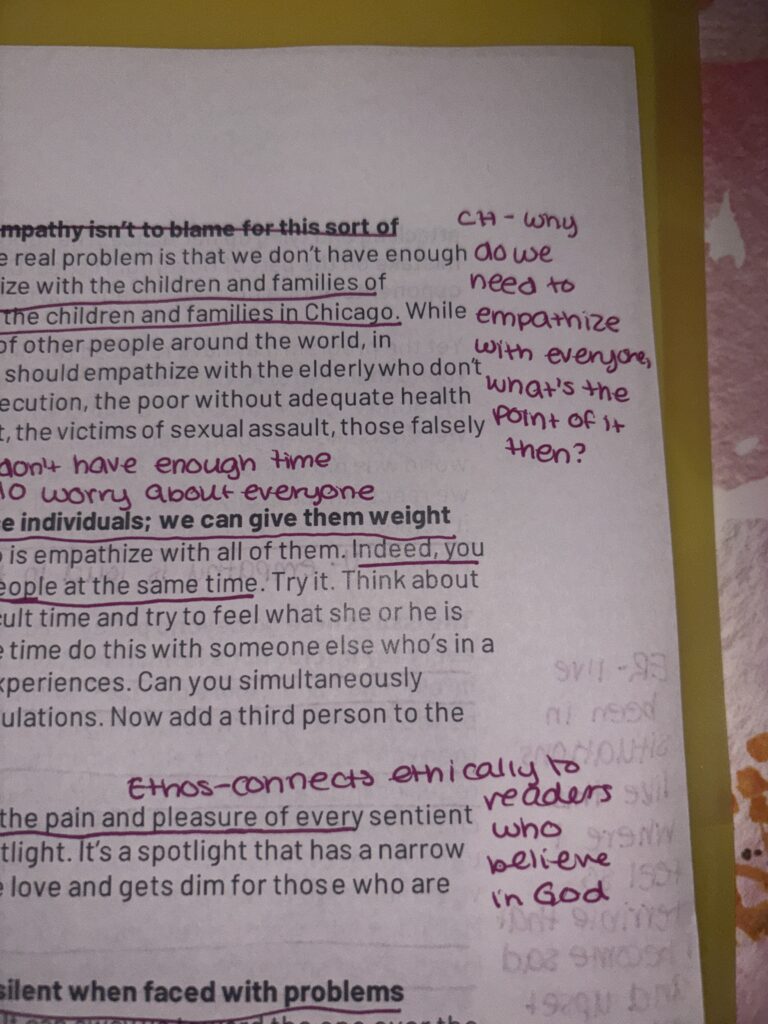
After reading over the annotation guide, I was able to adjust how I annotated for Konnikova’s Limits of Freedom. Before I even started reading, I had to preview the author and make sure that I understood who they were and what they stand for. When I actually began reading, instead of underlining and summarizing what the author was saying, I was able to ask questions, make connections, challenge the writer’s ideas, and deepen my understanding of the text. Looking back on those annotations, the majority of my annotations were those that challenged the author on her ideas regarding social media and friendships. In Konnikova’s text, she was talking about how social media can be used as a strategy to widen and expand your social circle for better business outcomes (3). I disagreed with her tactic to expand social circles using social media because “friendships will not be genuine if we’re trying to build social groups strategically, that’s not friendship”. Since I challenged her in the margins and used descriptive and meaningful words, I am able to look back on that small snippet and understand an entire paragraph of what Konnikova was saying. Not only does this save time, but it also lets me know what type of annotation I used with the abbreviations. On page two of Konnikova’s essay, I demonstrated how I use the abbreviations and the multiple different kinds of annotations. In class we discussed how to correctly cite sources and use paraphrasing, which to my surprise, I had been doing wrong as well. I noticed how most  of the time I use partial quotes instead of full quotes, when before I didn’t know there was a difference.  Now, I’ve switched the way I cite and paraphrase and my essays and writings look so much better. While my annotations have changed for the better, there is always room for improvement. One thing I’d like to work on is the specificity of my annotations, they could always use some spice to make them more meaningful and I hope to be able to achieve that in upcoming pieces. By using the annotation guide, I can now actually use my annotations and the time and effort I spent writing them becomes useful.

Annotations from Page 2 of Limits of Friendship

Annotations from Page 1 of The Hawk

1st Peer Review Response

For my first college peer review, the comments that I received were very positive, which I liked. The ones that were constructive criticism were mostly about adding in source integration styles that we went over class, or adding some specificity to my examples. The comments that were most helpful to me were about adding in what we had learned in class on paraphrasing and source integration because I didn’t have any points on that whatsoever. When I was reading others’ work, I noticed how important it is to use first person because it creates a direct connection to the reader, and automatically makes it more engaging and interesting. Some challenges that I faced while doing my first peer review was writing down what I thought they could change in their essay. I just wanted to say that it was great, and that I liked it and there was nothing wrong with it at all. I found it hard to write down what could be added or changed, but afterwards I felt good about the way I worded my criticism because I knew that it would be helpful and wouldn’t come off in a weird way. To make it better for next time, I will just write what I think and not worry too much about how I say things, and focus mostly on the positives.

css.php