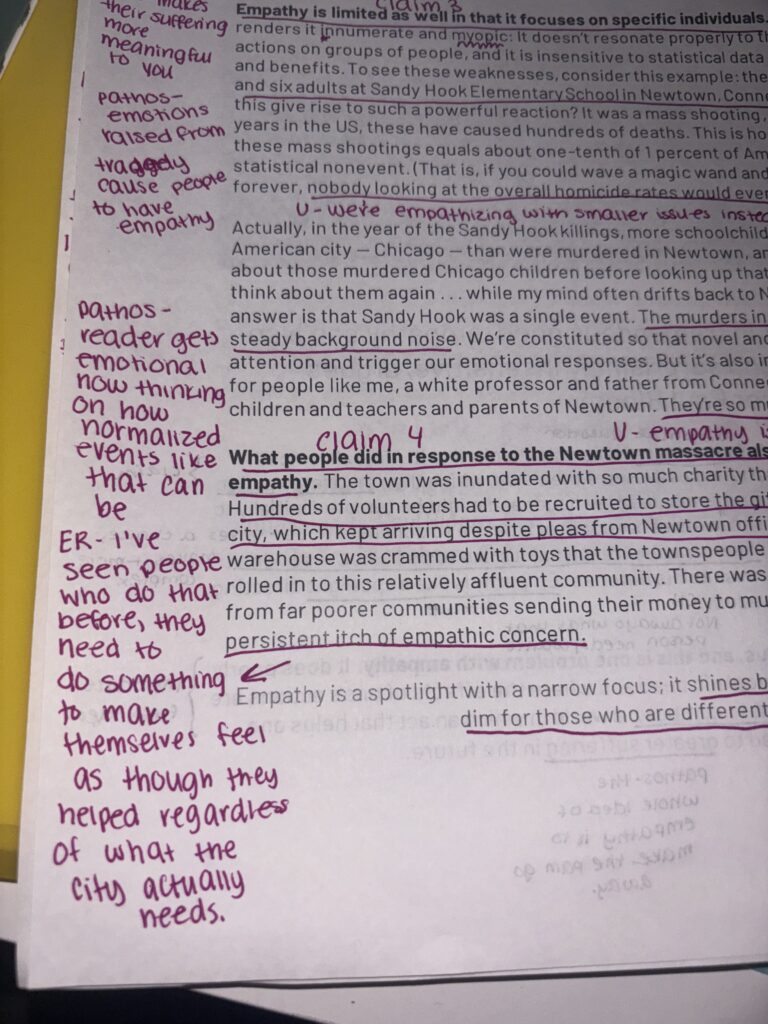
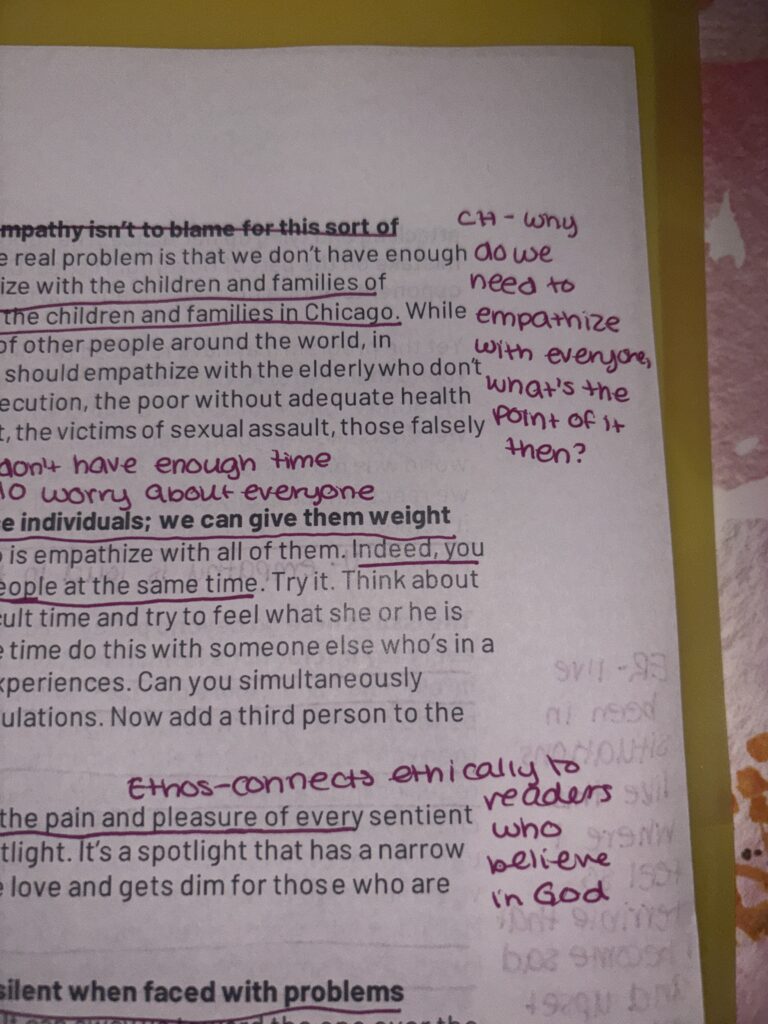
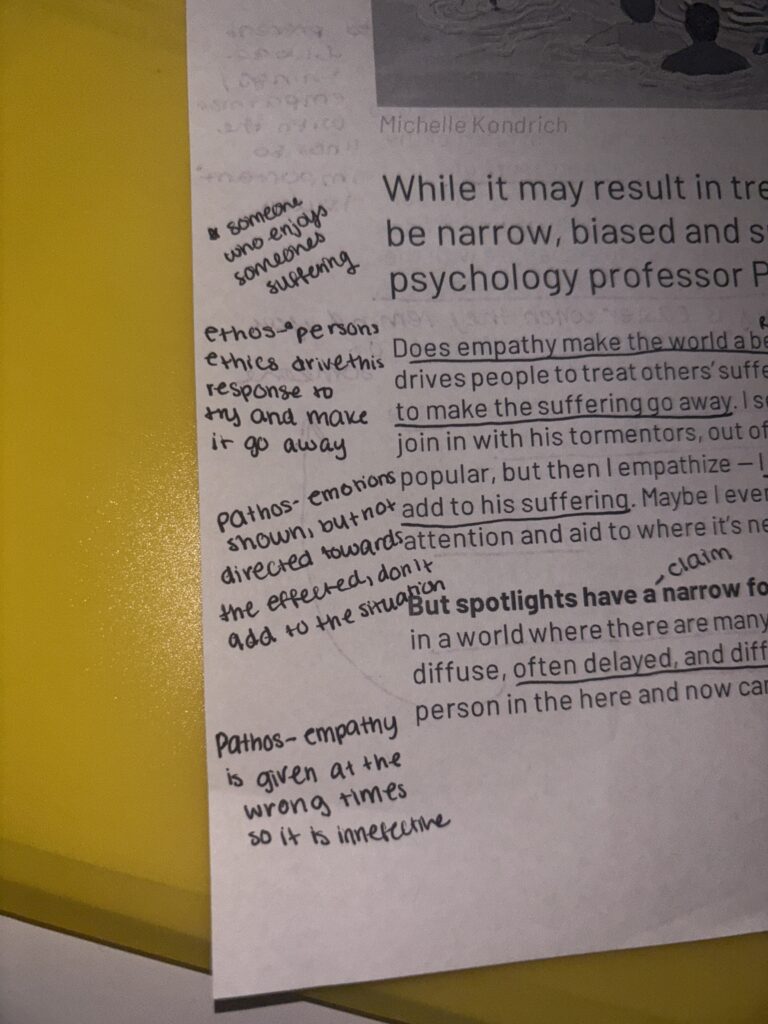
I always used to think that I was good at annotating, maybe because my handwriting is neat and I used fun colored pens that made it look like I was writing a ton of notes, but recently I’ve come to the realization that my annotating skills are not what I thought they were. In my annotations for The Hawk, they were superficial, just barely summarizing what was happening or what my thoughts were at that moment. I also tended to just underline sentences, thinking that it would be helpful later on, however, that just forces me to reread large sections to try to attempt to understand why that line was important. At the bottom of page one of The Hawk, you can see how I simply just underlined a sentence and called that good. One of my annotations from The Hawk was related to the reporter and what she was looking for and I wrote “the reporter wanted a sob story, not a story about how the community cared for him.” This annotation was completely unnecessary as the author made statements about how that was the entire point of the story Hawk was telling Doyle. My annotations for this story would look completely different if I had been using the annotation guide because I could have made connections to my life and would have actually written helpful notes in the margin instead of just writing to fill space.
After reading over the annotation guide, I was able to adjust how I annotated for Konnikova’s Limits of Freedom. Before I even started reading, I had to preview the author and make sure that I understood who they were and what they stand for. When I actually began reading, instead of underlining and summarizing what the author was saying, I was able to ask questions, make connections, challenge the writer’s ideas, and deepen my understanding of the text. Looking back on those annotations, the majority of my annotations were those that challenged the author on her ideas regarding social media and friendships. In Konnikova’s text, she was talking about how social media can be used as a strategy to widen and expand your social circle for better business outcomes (3). I disagreed with her tactic to expand social circles using social media because “friendships will not be genuine if we’re trying to build social groups strategically, that’s not friendship”. Since I challenged her in the margins and used descriptive and meaningful words, I am able to look back on that small snippet and understand an entire paragraph of what Konnikova was saying. Not only does this save time, but it also lets me know what type of annotation I used with the abbreviations. On page two of Konnikova’s essay, I demonstrated how I use the abbreviations and the multiple different kinds of annotations. In class we discussed how to correctly cite sources and use paraphrasing, which to my surprise, I had been doing wrong as well. I noticed how most of the time I use partial quotes instead of full quotes, when before I didn’t know there was a difference. Now, I’ve switched the way I cite and paraphrase and my essays and writings look so much better. While my annotations have changed for the better, there is always room for improvement. One thing I’d like to work on is the specificity of my annotations, they could always use some spice to make them more meaningful and I hope to be able to achieve that in upcoming pieces. By using the annotation guide, I can now actually use my annotations and the time and effort I spent writing them becomes useful.
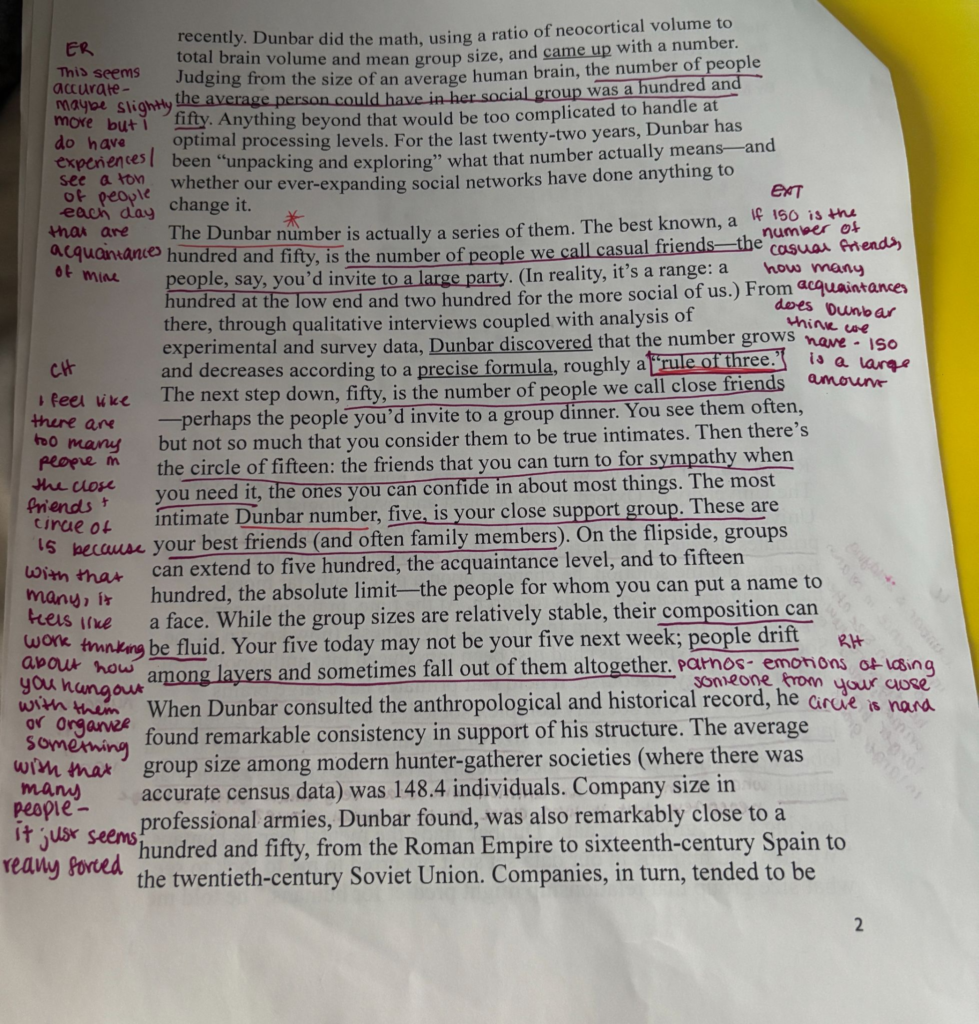
Annotations from Page 2 of Limits of Friendship
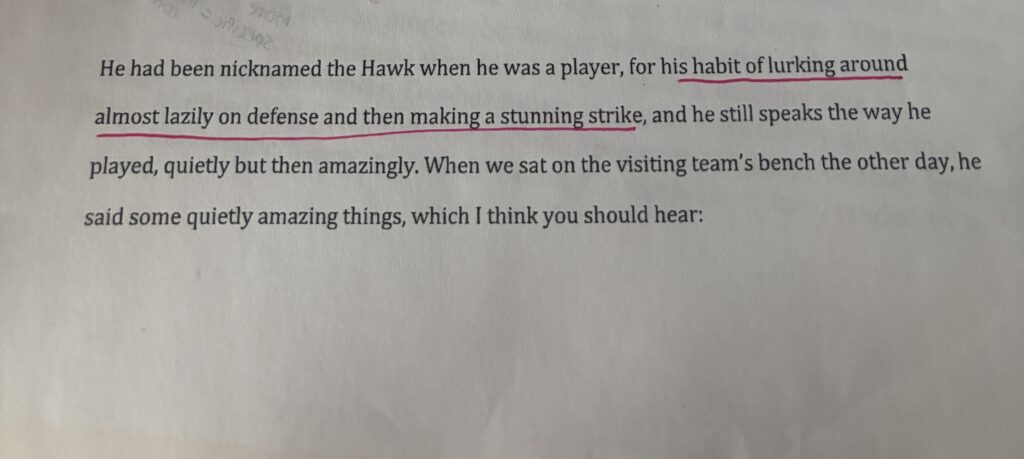
Annotations from Page 1 of The Hawk
For my first college peer review, the comments that I received were very positive, which I liked. The ones that were constructive criticism were mostly about adding in source integration styles that we went over class, or adding some specificity to my examples. The comments that were most helpful to me were about adding in what we had learned in class on paraphrasing and source integration because I didn’t have any points on that whatsoever. When I was reading others’ work, I noticed how important it is to use first person because it creates a direct connection to the reader, and automatically makes it more engaging and interesting. Some challenges that I faced while doing my first peer review was writing down what I thought they could change in their essay. I just wanted to say that it was great, and that I liked it and there was nothing wrong with it at all. I found it hard to write down what could be added or changed, but afterwards I felt good about the way I worded my criticism because I knew that it would be helpful and wouldn’t come off in a weird way. To make it better for next time, I will just write what I think and not worry too much about how I say things, and focus mostly on the positives.
© 2026 Ava Wolverton's ePortfolio
Theme by Anders Noren — Up ↑
